

Once you realize your Bookkeeping is months or years behind, that sinking feeling isn’t just about messy records.
It’s costing you real money every single day.
While you’ve been focused on running your business, those unreconciled bank statements and scattered receipts have been silently:
- Causing massive amounts of stress
- Undermining your financial foundation
- Creating dangerous cash flow blind spots
- Setting you up for costly tax penalties
You’re Not Alone In This Struggle
The statistics are staggering:
- 40% of small business owners spend over 80 hours per year on administrative tasks
- Bookkeeping represents the most time-consuming and stressful component
- 61% of small businesses admit they’re not confident in their financial record-keeping accuracy
- 29% have experienced cash flow problems directly related to poor Bookkeeping practices
- The average small business loses $10,000 annually due to Bookkeeping errors and missed opportunities
Here’s The Encouraging News
Catching up on your Bookkeeping and preventing future backlogs is entirely achievable with the right approach.
This comprehensive guide provides:
- A systematic roadmap for financial recovery
- Everything from initial assessment through sustainable systems
- How to efficiently organize months of backlogged transactions
- When to handle recovery internally versus seeking professional help
- Bulletproof processes that prevent future chaos
Your Transformation Starts Here
Whether you’re drowning in years of unreconciled statements or simply want to improve your current Bookkeeping and Accounting processes, this guide will transform your financial chaos into organized, compliant records that support confident business decision-making.
By the end, you’ll have:
- The knowledge to tackle any Bookkeeping backlog
- Tools to maintain accurate financial records
- Systems that serve your business growth rather than hindering it
Tired of Trying To “Figure Out” Your Financials?
Stop losing money to Bookkeeping disasters. Get your free assessment today.
SERVING: MD, VA, DC, DE, PA & Nationwide.
Qualified businesses with a Bookkeeping Budget move forward fast.
Table of Contents:
- The True Cost of Falling Behind on Your Books: Financial Consequences & Business Impact
- Initial Assessment: Where Do You Stand? Bookkeeping Health Check & Recovery Planning
- DIY vs. Professional Help: Making the Right Choice for Your Small Business Accounting
- The 6-Step Catch-Up Process: Complete Bookkeeping Recovery & Financial Cleanup
- Leveraging Technology for Efficiency: Best Accounting Software & Automation Tools
- Preventing Future Backlogs: Sustainable Bookkeeping Systems & Best Practices
- Conclusion and Next Steps: Your Path to Financial Recovery & Ongoing Success
I. The True Cost of Falling Behind on Your Books: Financial Consequences & Business Impact
I’m about to tell you something that’s going to save your business, and potentially your entire future. When your Bookkeeping falls behind, you’re not just dealing with some harmless paperwork mess. You’re bleeding money like a severed artery, and most entrepreneurs don’t even realize they’re dying until it’s too late. I’ve seen this scenario play out countless times with business owners who thought they could handle everything themselves.
Stop the Financial Bleeding Now
Every day costs you money. Don’t wait another minute.
SERVING: MD, VA, DC, DE, PA & Nationwide.
Qualified businesses with a Bookkeeping Budget move forward fast.
Financial Consequences
Let me paint you a picture of financial devastation that I’ve seen destroy more businesses than bad products or lousy marketing combined.
Cash flow visibility issues are like driving a Ferrari blindfolded at 120 mph. You think you’re in control until you slam into a brick wall. I’ve watched entrepreneurs make million-dollar decisions based on what they think is in their bank account, only to discover they’re actually broke. You might see $500,000 sitting there and feel like a king, but when those outstanding checks clear and reality hits, you’re suddenly scrambling to make payroll. It’s financial Russian roulette, and the house always wins. Without current financial records, you’re essentially flying blind when making critical spending decisions.
Tax penalties and missed deductions will absolutely destroy your bottom line. The IRS doesn’t give a darn about your excuses. They want their money, period. Meanwhile, you’re leaving legitimate business expenses on the table because you can’t locate documentation or properly categorize transactions. Here’s a number that’ll make you sick: small businesses typically miss 20-30% of available deductions when records are disorganized. That’s your money walking straight out of your pocket into Uncle Sam’s.
Loan application difficulties arise when lenders request financial statements and you show up empty-handed like you’re asking for charity. Banks demand up-to-date profit and loss statements, balance sheets, and cash flow projections. Without these, you’ll either get rejected faster than a bad pick-up line, or they’ll offer you terms so terrible that taking the money would be financial suicide.
Business Sale and Partnership Disasters: When you’re ready to sell your business or bring on strategic partners, messy financials kill deals before they start. Buyers and investors demand 3-5 years of clean financial statements, detailed cash flow analysis, and professional-grade due diligence materials. Your Incompetent Bookkeeper’s failures create red flags that destroy valuations and scare away serious buyers. I’ve seen million-dollar businesses sell for 30-50% less than market value because their accounting disasters made them appear risky investments. Professional buyers walk away immediately when they discover reconciliation gaps, missing documentation, or unreliable financial reporting that signals operational chaos.
Investor relations problems can kill your growth dreams before they even start. I know what investors want. They expect professional-grade financial reporting that proves you know what you’re doing. Show up with sloppy Bookkeeping, and you’re basically telling them you’re an amateur who can’t be trusted with a dollar, let alone their investment.
Operational Impact
Beyond the direct financial carnage, Bookkeeping disasters create operational chaos that will strangle your business from the inside out.
The time drain on core business activities is absolutely devastating. Instead of focusing on what actually makes you money (sales, product development, customer service) you’re spending precious weekend hours playing detective with bank statements, trying to remember what that mysterious $247 charge was three months ago. Every hour wasted on this mess is an hour not spent building your empire.
Stress and decision-making paralysis will turn you into a nervous wreck. When you don’t know your true financial position, every business decision becomes a terrifying gamble. Should you hire that superstar employee? Can you afford that game-changing equipment? Without accurate financial data, these strategic opportunities become sources of pure anxiety instead of stepping stones to success. I’ve seen business owners become paralyzed, unable to make decisions because they’re operating in complete financial darkness.
Compliance risks and audit vulnerabilities multiply like rabbits in springtime. The longer you wait, the more mistakes pile up, and if you ever get audited, whether by the IRS, state agencies, or during a business transaction, incomplete records will result in penalties that could destroy everything you’ve built.
Growth limitations due to poor financial insight represent the ultimate tragedy in my book. You can’t optimize what you can’t measure, and without regular financial reporting, you’re missing golden opportunities to improve profit margins, identify your most profitable customers, and spot trends that could revolutionize your entire strategy.
Common Scenarios Leading to Bookkeeping Backlogs
I’ve seen these patterns destroy countless businesses, so pay attention to these warning signs before they take you down.
Rapid business growth overwhelming internal systems is actually a champagne problem, but it’ll kill you if you don’t handle it right. When your revenue doubles but your Bookkeeping processes stay stuck in the stone age, something’s got to give. I’ve watched success turn into complete chaos overnight without proper Accounting and Bookkeeping services scaling alongside growth. Many businesses experience this when they go from startup mode to needing someone to take control of their entire Accounting department.
Staff turnover in Accounting roles creates instant disasters. When your Bookkeeper walks out the door, they take all the institutional knowledge with them. If they didn’t document their systems properly (and trust me, most don’t) you’re starting from absolute zero, like a rookie on their first day. The worst part? You constantly have to repeat yourself to new people trying to understand your business.
Inadequate Bookkeeper accounting software implementation handicaps you from day one. Too many businesses choose software based on price instead of power, then wonder why everything’s a struggle. Without proper integration between banking systems and accounting platforms, you’re stuck doing manual data entry like it’s 1985. I’ve seen companies struggle for years because they didn’t invest in the right systems from the beginning.
Mixing personal and business expenses creates a tangled web that becomes nearly impossible to unravel. What starts as one “emergency” personal charge becomes a dangerous pattern that makes accurate Bookkeeping about as likely as hitting the lottery twice in one week. This is one of the fastest ways to turn a simple catch-up project into a complete financial mess that requires extensive detective work to sort out.
II. Initial Assessment: Where Do You Stand? Bookkeeping Health Check & Recovery Planning
Before you dive headfirst into catch-up mode like some amateur trying to fix years of financial chaos in a weekend, you need to take a step back and get a crystal-clear picture of your current situation. I’ve seen too many business owners make this critical mistake. They start throwing money and time at the problem without understanding exactly what they’re dealing with. This assessment will guide your recovery strategy and help you allocate resources like the strategic professional you need to become.
Get Your Bookkeeping Health Score
Find out exactly where you stand in just 5 minutes.
SERVING: MD, VA, DC, DE, PA & Nationwide.
Qualified businesses with a Bookkeeping Budget move forward fast.
Bookkeeping Health Check
Start by conducting a comprehensive audit of your financial record-keeping status. Identify missing months or quarters by creating a simple timeline showing when your last complete reconciliation occurred. Here’s what I see happen over and over: many businesses discover they’re actually further behind than initially thought. What seemed like “a few missing weeks” often extends back several months. Our books are a mess is the reality most business owners face when they finally look under the hood.
Assess data quality and completeness of existing records. Even if you have some documentation, you need to check for accuracy and thoroughness like your business depends on it, because it does. Are transactions properly categorized? Do your bank reconciliations actually balance? Are customer invoices and vendor bills properly recorded? I’ll tell you something that’ll shock you: poor-quality data is sometimes worse than no data, as it creates false confidence in your financial position. It’s like thinking you’re driving a Ferrari when you’re actually behind the wheel of a broken-down jalopy.
Review existing Bookkeeping and Accounting processes to understand what’s working and what’s broken beyond repair. Document your current workflow from transaction occurrence to financial reporting. This reveals bottlenecks and gaps that contributed to your backlog and need addressing during recovery. The current Accountant couldn’t get financial reports in place is a story I hear constantly from business owners who are drowning in financial chaos.
Evaluate current software and systems for adequacy. Is your Bookkeeper accounting software meeting your needs, or are you outgrowing basic tools like a successful business should? Check if systems talk to each other properly. Disconnected platforms often create duplicate work and increase error rates. Getting Quickbooks up to date is already giving him a headache is exactly the kind of pain point that signals you need professional intervention.
Prioritization Framework
Not all Bookkeeping tasks carry equal urgency, and understanding this hierarchy is what separates the pros from the amateurs.
Tax deadline considerations should top your list. Whether facing quarterly estimated payments, annual returns, or sales tax filings, government deadlines are non-negotiable. Missing these creates penalties that compound quickly and can destroy your cash flow faster than a market crash.
Loan or financing needs timeline determines how quickly you need clean financial statements. If you’re applying for credit within the next 90 days, prioritize generating current profit and loss statements and balance sheets that lenders require. Bank is requesting P&L and BS from past years is the wake-up call that forces most business owners to finally address their Bookkeeping disasters.
Investor reporting requirements vary by agreement but often include monthly or quarterly financial packages. Maintaining investor confidence requires meeting these commitments consistently. Lose their trust, and you lose access to the capital that fuels your growth.
Cash flow urgency levels help prioritize which periods to tackle first. Cash flow is always an issue for businesses operating in financial darkness, so focus on recent months that impact current decision-making, then work backward systematically.
Due Diligence and Exit Planning Readiness When Selling Your Business: You’re planning to sell your business or bring on investors, but your financial records can’t withstand professional scrutiny. Internal business audits reveal the true scope of bookkeeping disasters – missing documentation, incorrect categorizations, and compliance gaps that destroy deal valuations. Smart business owners prepare their financials years before exit opportunities, while those with bookkeeping chaos discover their businesses are essentially unsellable without extensive financial reconstruction.
Resource Inventory
Now it’s time to honestly assess what you have available for the recovery effort, and I mean being brutally honest.
Internal team capabilities determine how much you can realistically handle in-house. Do you have staff with Bookkeeping experience, or will everything require external support? Factor in their existing workload because recovery efforts shouldn’t derail daily operations. Most business owners I encounter don’t have a good handle on their numbers and desperately need assistance with getting their financials back on track.
Available documentation affects the complexity and timeline of your catch-up project. Gather bank statements, credit card records, receipts, invoices, and previous tax returns. Digital records are easier to process, but don’t overlook paper documentation that needs scanning and organization. I’ve seen businesses become so disconnected from their financial data that they have to ask their CPA firm for basic backup files just to access their own records.
Technology infrastructure includes both hardware and software capabilities. Do you have adequate computing power, secure data storage, and reliable internet for cloud-based Bookkeeping and accounting systems? You want your financial systems to be simple, efficient, and user-friendly – just like the best websites that are very easy to navigate and understand.
Budget for recovery efforts influences whether you handle this internally, hire temporary help, or engage outsourced Bookkeeping services. Professional help costs more upfront but often proves more economical when considering accuracy, speed, and the opportunity cost of diverting internal resources from revenue-generating activities. I constantly hear from business owners who say they have no budget, but getting their books up to date is already giving them major headaches – this reactive mindset keeps businesses stuck in financial chaos indefinitely. Businesses need a Bookkeeping Budget.
III. DIY vs. Professional Help: Making the Right Choice for Your Small Business Accounting
This is where most business owners make the critical mistake that costs them thousands and months of their life that they’ll never get back. The decision between handling catch-up Bookkeeping internally versus seeking professional assistance depends on multiple factors unique to your business situation, and making the wrong choice can cost valuable time and money. I’ve seen brilliant entrepreneurs throw away fortunes because they thought they could save a few bucks doing everything themselves.
Ready For Professional Help?
Get my expert guidance on your best Bookkeeping solution today.
SERVING: MD, VA, DC, DE, PA & Nationwide.
Qualified businesses with a Bookkeeping Budget move forward fast.
When to Handle It Yourself
Let me be brutally honest about when DIY actually makes sense and when you’re simply kicking the can down the road.
Simple business structures like sole proprietorships or single-member LLCs with straightforward operations are often suitable for DIY approaches. If you’re primarily a service business with minimal inventory, few employees, and uncomplicated revenue streams, the learning curve for basic Bookkeeping remains manageable. But here’s the key: you need to be realistic about your situation, not optimistic.
Limited transaction volume makes self-management feasible. Businesses processing fewer than 100 transactions monthly can often catch up using quality Bookkeeper accounting software without overwhelming their internal capacity. However, volume isn’t the only consideration because transaction complexity matters equally. I’ve seen simple businesses with complex transactions that would challenge seasoned professionals.
Adequate internal expertise is crucial for success. If you or a team member has previous Bookkeeping experience, understands basic Accounting principles, or demonstrates strong attention to detail and organizational skills, DIY becomes maybe viable. Without this foundation, mistakes multiply quickly during catch-up efforts. Most business owners I meet don’t have a good handle on their numbers and desperately need assistance. This describes the majority who think they can wing it.
Sufficient time availability determines whether good intentions translate into results. Catching up on six months of backlogged Bookkeeping typically requires 40-80 hours of focused work. Go back 12 – 60 months? Hundreds of hours. Can you dedicate this time without neglecting core business operations? Underestimating the time commitment is a common pitfall that destroys more businesses than market crashes.
Understanding Professional Options
Now let’s talk about the real solutions that successful businesses use to dominate their markets.
Bookkeeper vs Accountant: Key Differences
Understanding the scope of services comparison helps you choose the right professional for your situation. Bookkeepers focus on daily transaction recording, bank reconciliations, and basic financial statement preparation. Accountants provide strategic financial analysis, tax planning, audit support, and complex compliance guidance. Most businesses getting started need Bookkeepers, not Accountants.
Qualification requirements vary significantly. Bookkeepers may hold certificates from programs or professional associations but aren’t licensed. CPAs must complete extensive education, pass rigorous examinations, and maintain continuing education requirements, which explains their higher fees. When you need someone who can fix years of accumulated Bookkeeping disasters, 15 years of experience and stellar reviews matter more than fancy credentials or expensive certifications.
Cost considerations reflect these qualification differences. Quality Bookkeepers typically charge $70-$95 per hour, while CPAs command $200-$400 hourly. Lousy ones? $25-$50 per hour and $100-$150 respectively. But like anything, you pay for what you get. For catch-up work focused on organizing and recording transactions, Bookkeepers often provide better value. I’ve seen businesses pay CPA rates for work that any competent Bookkeeper could handle for half the price. The problem is that too many service providers don’t know what they’re doing and refuse to listen to what their clients actually need, which makes choosing the right professional even more critical.
Which professional you need depends on your business complexity. Choose Bookkeepers for transaction processing, reconciliations, and basic financial reporting. Engage Accountants for more advanced needs like tax strategy, financial analysis, loan packaging, or when facing IRS issues and compliance challenges.
Virtual Bookkeeper Benefits
Here’s where modern technology gives smart business owners a massive advantage over their competitors.
Cost-effective remote solutions eliminate overhead costs associated with in-house staff while providing professional expertise. Virtual Bookkeepers offer the best value for you since you’re not hiring a W-2 employee. Business owners consistently tell me they’re looking for someone who responds to emails promptly and actually gets things done. That describes exactly what you get with quality virtual Bookkeepers.
Access to specialized expertise means you’re not limited to local talent. Virtual Bookkeepers who are still local, often specialize in specific industries or software platforms, bringing targeted knowledge to your situation. I’ve had clients complain that every Accounting firm they call connects them to someone in India because everything gets outsourced overseas. This shows why working with quality domestic and local virtual Bookkeepers provides such a competitive advantage.
Flexible service arrangements allow you to scale support up or down based on needs. This proves particularly valuable during catch-up periods when you need intensive short-term help followed by ongoing maintenance support. Many clients confide that they’re exhausted from bringing work stress home every night. That’s exactly the freedom that proper virtual Bookkeeping provides.
Technology advantages distinguish modern virtual Bookkeepers. They’re typically proficient with cloud-based Bookkeeping and accounting software, automation tools, and secure document sharing platforms that streamline collaboration. Clients often tell me they appreciate working with actual professionals rather than some impersonal call center. This demonstrates the personal attention you can get from the right virtual provider.
Outsourced Bookkeeping Services Overview
This is where businesses serious about growth make their move.
Full-service Accounting and Bookkeeping services provide comprehensive solutions including transaction processing, reconciliations, financial reporting, and often tax preparation. This approach works well for businesses wanting complete financial management support. Clients consistently value having everything handled under one roof as a complete solution. That’s what separates the pros from the amateurs in this space.
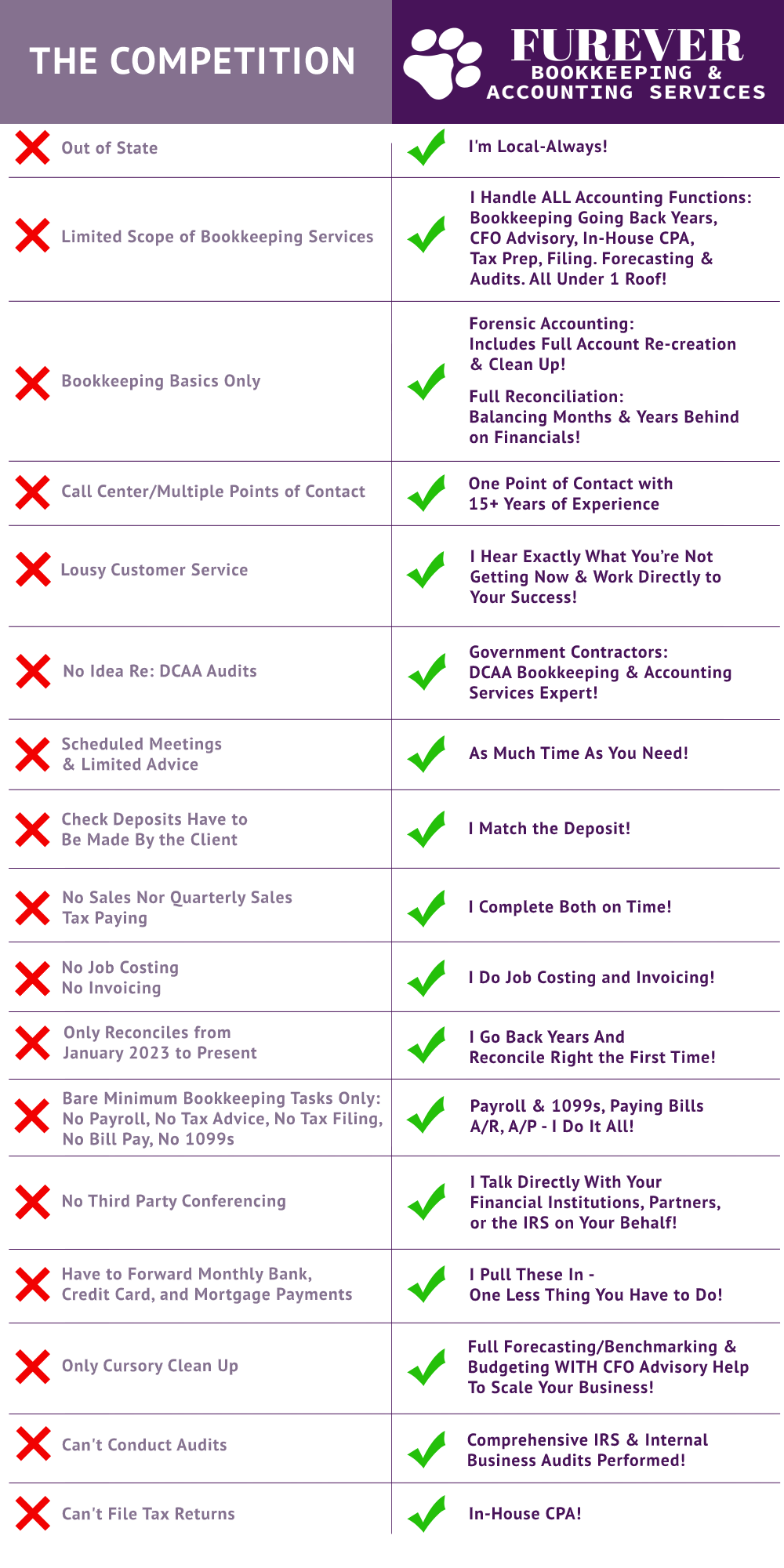
Scalable solutions for growing businesses adapt as your needs evolve. Most outsourced Bookkeeping services offer tiered packages that expand with your transaction volume and complexity requirements. I’ve had successful entrepreneurs tell me they want to completely outsource their Accounting department rather than managing it internally. This represents the mindset of smart business owners who focus on what they do best. The right-hand column in the illustration below best represents what scaling business are looking for in an expert Bookkeeper.
Compliance and accuracy guarantees provide peace of mind. Professional services typically carry errors and omissions insurance and guarantee their work, something impossible with DIY approaches. I’ve had clients share horror stories about using services like Bench or Quickbooks Live with terrible customer support that never reviewed reports properly. This shows what happens when you choose the wrong provider.
Integration with existing systems ensures smooth transitions. Quality providers work with your current Bookkeeper accounting software and can recommend upgrades when necessary. During consultations, I provide detailed explanations of our services in a well-organized presentation. This demonstrates the systematic approach that separates professional services from amateur hour.
Hybrid Approaches
Smart business owners often use combination strategies that give them the best of both worlds.
Combining internal and outsourced Bookkeeping often provides optimal results. Keep simple tasks like receipt organization and data entry in-house while outsourcing complex reconciliations and financial reporting to professionals. Clients often tell me they specifically want organized professionals who demonstrate clear systematization. This shows the level of structure required for success.
Seasonal support strategies work well for businesses with fluctuating needs. Handle routine periods internally while engaging virtual Bookkeepers during busy seasons, year-end closing, or tax preparation periods. Many clients explain that running seasonal businesses makes cash flow management absolutely critical. Companies like this benefit most from flexible arrangements.
Training and knowledge transfer turns professional relationships into learning opportunities. Many Bookkeepers provide training to help you maintain records between their visits, building internal capability while ensuring professional oversight. Successful business owners often tell me they need guidance and mentorship to achieve real growth. This represents the advisory aspect that transforms businesses from chaos to systematic success.
IV. The 6-Step Catch-Up Process: Complete Bookkeeping Recovery & Financial Cleanup
This systematic approach transforms Bookkeeping chaos into organized financial records. Follow these steps sequentially for the most efficient recovery process, and trust me, I’ve seen this method save countless businesses from financial ruin.
Need Help With Your Catch-Up?
Let me handle your recovery process now.
SERVING: MD, VA, DC, DE, PA & Nationwide.
Qualified businesses with a Bookkeeping Budget move forward fast.
Step 1: Audit Existing Work and Gather Documentation
For $1-5M businesses with existing (but problematic) bookkeeping:
Before assuming anything in your current system is accurate, conduct a forensic audit of your bookkeeper’s work. Your business is too large and complex to operate on assumptions. Start by reviewing their reconciliation history, when was the last time accounts were actually balanced? I’ve discovered bookkeepers at million-dollar businesses who haven’t properly reconciled in 6+ months, creating cascading errors that distort every financial decision.
Critical audit checkpoints:
- Compare your accounting system balances to actual bank balances for the last 6 months
- Review major expense categorizations. Consulting fees buried under “office supplies”?
- Verify payroll tax deposits match what’s recorded in your books
- Check if inter-company transactions (if applicable) are properly eliminated
- Examine how they’ve handled loan payments, equipment purchases, and other complex transactions
Common problems with existing bookkeepers: Many business owners discover their current bookkeeper couldn’t get financial reports in place when banks or investors request them. I frequently encounter situations where bookkeepers have made a mess of the records, haven’t filed taxes since 2022, or completely wrecked the financials like QuickBooks Live did for several of my clients. Getting QB’s up to date is already giving business owners major headaches because their bookkeeper has been MIA or incompetent.
Documentation recovery for established businesses:
Your existing bookkeeper should have maintained organized digital files, but don’t count on it. Clients often tell me they have to ask their CPA firm for basic backup files just to access their own records. Gather all vendor contracts, customer master agreements, loan documents, and recurring payment schedules. Include payroll summaries, benefits documentation, and any multi-entity transaction records if you have subsidiaries or partnerships.
Red flags requiring immediate attention:
- Bank reconciliations that don’t balance or haven’t been completed monthly
- Mysterious “suspense” or “clearing” accounts with large balances
- Personal expenses mixed with business transactions (comingled funds)
- Missing documentation for major purchases or payments
- Inconsistent month-to-month reporting that shows unexplained variances
- Books that have never been reconciled—ever
Document organization for complex businesses: Create separate folders for each entity, department, or profit center. Use consistent naming conventions that include dates and transaction types. For businesses with multiple revenue streams, organize by business line to maintain clarity during the cleanup process.
When you need professional intervention: If you discover your books are a mess and you need someone who can take control of your entire Accounting Department, don’t delay. Many successful business owners realize they need to outsource their entire Accounting Department rather than continue struggling with incompetent internal staff. The goal isn’t just gathering papers. It’s understanding what’s been missed, miscategorized, or completely ignored by your previous bookkeeping arrangement.
Step 2: Reconcile Bank Accounts
For $1-5M businesses dealing with reconciliation disasters:
Bank reconciliation forms the foundation of accurate bookkeeping, but for established businesses with problematic bookkeepers, this step often reveals shocking discrepancies. Start with the most recent month and work backward because this approach helps you spot patterns and gives you current information for immediate decision-making needs.
When your previous bookkeeper failed you: Many business owners discover their bookkeeper hasn’t reconciled accounts in months, leaving thousands of dollars in unexplained differences. I’ve seen situations where current accountants struggle with AP and AR and can’t get reports completed in a timely manner. If your books have never been reconciled, ever, you’re about to uncover financial chaos that’s been hiding in plain sight.
The reconciliation reality check: Focus on identifying and categorizing transactions as you go, but don’t expect perfection initially. Your previous bookkeeper may have left mysterious adjustments and transactions recorded in the wrong month. Broad categories like “office expenses” or “marketing” work fine for the first pass. You can refine categorization later once all transactions are recorded. Getting QB’s up to date should be the immediate priority.
Systematic approach for complex businesses: Handle discrepancies and missing items systematically. Common issues in $1-5M businesses include outstanding checks, deposits in transit, bank fees, loan payments split incorrectly between principal and interest, and personal expenses mixed with business transactions. Keep a running list of items requiring follow-up research rather than stopping progress entirely. Banks are requesting current P&L and balance sheets for credit lines and loan renewals, so accuracy matters more than speed.
Technology solutions for efficiency: Use bookkeeper accounting software for efficiency by connecting bank feeds when possible. Most modern platforms automatically import transactions, reducing manual data entry by 70-80%. However, many established businesses discover their current bookkeeper couldn’t handle the account properly due to software limitations or incompetence. Set up bank connections for all business accounts to streamline future reconciliations.
Prevention systems for growing businesses: Establish best practices for ongoing reconciliation during this process. For businesses doing $1-5M annually, reconcile accounts weekly rather than monthly to prevent future backlogs. Many successful business owners realize they need someone who can take control of their entire Accounting Department rather than hoping an internal person will eventually figure it out. Create checklists and standard procedures that work for your business complexity. Monthly reconciliations should be completed promptly to maintain financial accuracy and support strategic decision-making.
When to seek professional help: If you discover bank reconciliations that don’t balance or haven’t been completed in over 90 days, you need immediate professional intervention. Businesses often find they need someone organized who can handle the complexity of multiple accounts, entities, and transaction types without constantly having to repeat themselves to a new person. The reconciliation process should provide cash flow visibility that supports confident business decisions, not create more confusion.
Step 3: Categorize Transactions and Expenses
For $1-5M businesses fixing categorization disasters:
Accurate categorization enables meaningful financial reporting and tax compliance, but many established businesses discover their previous bookkeeper made a hot mess of their chart of accounts. Rather than looking at the COA (chart of accounts) in place, incompetent bookkeepers often tried to setup their own COA which was a hot mess. Begin by setting up a proper chart of accounts that reflects your business structure and industry complexity.
Cleaning up categorization chaos: Your previous bookkeeper may have buried consulting fees under “office supplies” or created dozens of meaningless categories that provide no business insight. Most bookkeeper accounting software includes industry-specific templates that provide excellent starting points, but many bookkeepers don’t know what they’re doing and don’t listen to industry best practices.
Strategic categorization for growing businesses: Develop expense categorization strategies that balance detail with simplicity for your revenue level. Too many categories create confusion; too few provide insufficient insight for $1-5M businesses. Common categories include office supplies, marketing/advertising, professional services, utilities, and travel expenses. Create subcategories only when necessary for tax reporting or management analysis. Proper categorization prevents thousands in missed deductions – money that incompetent bookkeepers leave on the table every year.
Revenue recognition for complex businesses: Apply revenue recognition principles consistently across multiple revenue streams. Generally, record income when earned (accrual method) rather than when received (cash method), though some businesses may use either approach. For businesses with government contracts or multiple entities, ensure your method aligns with compliance requirements and remains consistent throughout the year. Many businesses don’t have a good handle on their numbers because their categorization methods are inconsistent.
Complex transaction expertise: Handle complex transactions like loan payments (split between principal and interest), asset purchases (capitalize versus expense), inter-company transactions, and multi-purpose expenses (apportion appropriately). For businesses with multiple revenue streams or subsidiaries, proper categorization becomes critical for accurate reporting. When unsure, consult tax guidelines or seek professional advice rather than guessing. Complex transactions require expert knowledge to avoid costly mistakes that can trigger audits or penalties.
Integration and system reliability: Ensure integration between bookkeeping and accounting systems by using consistent account codes and descriptions. This prevents reconciliation issues later and supports accurate financial reporting for banks requesting current P&L and balance sheets. Many businesses discover they need someone organized who understands how different software platforms should work together rather than creating disconnected data silos.
When categorization becomes critical: For businesses pursuing 8A certification, DCAA compliance, or preparing for audits, proper categorization isn’t optional – it’s mandatory. Current accountants who struggle with complex categorization requirements can destroy your compliance status and cost you valuable contracts. Regular backup procedures protect against data loss during this critical phase, especially when transitioning from an incompetent bookkeeper to professional management.
Step 4: Handle Accounts Receivable and Payable
For $1-5M businesses with AR/AP disasters:
Managing outstanding receivables and payables provides immediate cash flow benefits, but many established businesses discover their current accountant was struggling with AP and AR and couldn’t get completed in a timely manner. This creates dangerous cash flow blind spots that can destroy otherwise profitable businesses.
Receivables recovery for growing businesses: Start with outstanding invoice management by creating a comprehensive list of unpaid customer invoices. Your previous bookkeeper may have failed to track receivables properly, leaving money on the table. Verify amounts, dates, and contact information before beginning collection efforts. For businesses with government contracts or multiple revenue streams, ensure proper invoicing procedures are established and documented.
Payment tracking systems: Implement customer payment tracking systems that monitor payment patterns and flag overdue accounts. Many businesses discover they’re owed significantly more money than expected during catch-up efforts – sometimes tens of thousands in overlooked receivables. Prompt follow-up on overdue accounts can significantly improve cash flow, especially for businesses where cash flow is always an issue.
Strategic vendor management: Organize vendor payment organization by creating a master list of amounts owed, due dates, and payment terms. For businesses doing $1-5M annually, vendor relationships are critical for operations and growth. Prioritize payments based on importance to operations, early payment discounts, and relationship considerations. Don’t let catch-up efforts damage vendor relationships through delayed payments – your reputation depends on it.
Aging and collection strategies: Generate aging reports and collection strategies that categorize receivables by age (current, 30 days, 60 days, 90+ days). Focus collection efforts on accounts with the highest probability of recovery. Consider payment plans for large overdue amounts rather than write-offs. Many businesses need someone who can pick up the phone and ask questions about overdue accounts rather than letting them languish indefinitely.
Cash flow visibility for strategic decisions: Conduct cash flow impact analysis by projecting when receivables will convert to cash and when payables require payment. This analysis often reveals seasonal patterns or timing issues that inform future business decisions and cash management strategies. Cash flow visibility becomes critical for strategic planning, especially when banks are requesting current P&L and balance sheets for credit decisions.
When professional management becomes essential: For businesses that have grown beyond simple operations, AR is done every day but the owner doesn’t know what is getting done. This represents a dangerous lack of visibility that professional bookkeeping solves. Current AP and AR reports that don’t align with projections create serious planning problems that can derail growth initiatives. Many successful business owners realize they need someone organized who can provide weekly reports or even daily cash flow visibility rather than operating in financial darkness.
Step 5: Payroll and Tax Compliance
For $1-5M businesses with payroll disasters:
Payroll errors create serious legal and financial consequences requiring immediate attention, especially when your previous bookkeeper wasn’t reporting all of their employees’ withholdings or made costly compliance mistakes. For growing businesses with multiple employees in different states, the complexity multiplies exponentially.
Employee compensation audit: Begin with employee compensation reconciliation by verifying gross pay, overtime calculations, and salary adjustments for each employee throughout the catch-up period. Many businesses discover their bookkeeper miscalculated payroll tax deferrals, created timeliness issues, or failed to handle weekly payroll properly. For businesses with 27 employees on weekly payroll or similar complexity, these errors compound quickly.
Tax verification and penalty prevention: Perform payroll tax verification for federal, state, and local withholdings. Ensure all deposits were made correctly and on time. Late or incorrect payroll tax deposits trigger penalties that compound quickly – I’ve seen businesses face tax liabilities because their bookkeeper wasn’t a financial wizard and missed critical deadlines. Contact tax authorities immediately if you discover missing or incorrect payments. Payroll compliance issues escalate rapidly without prompt attention.
Benefits and deduction accuracy: Review benefits and deduction accuracy including health insurance premiums, retirement plan contributions, and other voluntary deductions. For established businesses, ensure employee deductions match what was actually withheld and that employer matches were calculated correctly. Many businesses moving from Gusto to Paychex for automation discover discrepancies during the transition that require immediate correction.
Filing compliance catch-up: Complete quarterly filing catch-up for 941 forms, state unemployment reports, and other required payroll filings. Many businesses discover they’ve missed filing deadlines during catch-up efforts, especially when their bookkeeper was MIA or incompetent. File all missing returns immediately to minimize penalties – delays only make the financial damage worse.
Multi-state complexity management: Address state and local compliance requirements which vary significantly by location. Some jurisdictions require monthly remittances while others are quarterly. For businesses with employees in multiple states like Maryland, Virginia, Delaware, Texas, and Florida, research requirements for each location where you have employees to ensure full compliance. Multi-state payroll creates additional complexity that demands careful attention and often requires government bookkeeping experience.
When professional expertise becomes mandatory: Businesses doing $1-5M annually with employees in different states need someone who understands complex payroll compliance requirements. Current accountants who struggle with payroll issues can create liability exposure that threatens your entire business. Many successful business owners realize they need to outsource payroll and bookkeeping to professionals rather than hoping internal staff will figure out increasingly complex requirements. The cost of professional management is minimal compared to the penalties and legal exposure from payroll mistakes.
Step 6: Generate Financial Reports and Analysis
For $1-5M businesses requiring professional-grade reporting:
Financial reports transform organized data into actionable business intelligence, but many established businesses discover their current bookkeeper couldn’t get financial reports in place when banks, investors, or buyers request them. Professional reporting separates successful growing businesses from those stuck in operational chaos.
Essential financial statements: Start with profit and loss statements that summarize income and expenses for specific periods. Compare current performance to prior periods and budget projections to identify trends and variances. Banks are requesting current P&L and balance sheets for credit decisions, and delays cost you opportunities. Many business owners tell me they need financial reports as they are looking to purchase another business or expand operations.
Balance sheet accuracy: Prepare balance sheets showing assets, liabilities, and equity at specific points in time. Balance sheets must balance (assets = liabilities + equity) and provide snapshots of financial position. Use these reports to calculate key ratios like debt-to-equity and current ratio. For businesses with multiple entities or complex structures, accurate balance sheets become critical for audit support and compliance requirements.
Cash flow visibility: Create cash flow statements that track cash movement through operating, investing, and financing activities. Cash flow statements reveal whether profitability translates to actual cash generation, a critical distinction for business survival and growth planning. Cash flow analysis drives strategic decisions – especially for seasonal businesses where cash flow is always an issue. Many clients need weekly cash flow reports or even daily cash flow visibility to manage operations effectively.
Performance tracking systems: Establish key performance indicator tracking relevant to your industry and business model. For businesses with government contracts, track metrics like labor utilization and indirect rates. For service businesses, monitor gross profit margin, customer acquisition cost, and average transaction size. Regular KPI monitoring enables proactive management decisions rather than reactive responses that damage profitability.
Strategic analysis capabilities: Conduct financial trend analysis for decision-making by comparing multi-period reports to identify patterns, seasonality, and growth trajectories. This analysis often reveals opportunities for cost reduction, pricing optimization, or strategic investments that weren’t apparent from daily operations. Financial insights fuel business growth when properly analyzed and implemented by professionals who understand your industry.
Exit and Partnership Readiness: Internal audits become strategic advantages when your financial systems can demonstrate operational excellence and growth potential to stakeholders. Preparing for business sale or partnership discussions requires comprehensive financial documentation that most incompetent accountants simply cannot provide, leaving money on the table and deals dead in the water.
Professional reporting standards: For established businesses, monthly reporting should include budgets vs actuals comparisons and variance analysis. Many successful business owners need quarterly strategy calls and forecasting support to plan growth initiatives. Bi-weekly financial reporting keeps management informed without overwhelming them with data. Professional reporting supports confident decision-making whether you’re looking to double revenue, planning succession, or preparing for 8A certification.
When reporting becomes strategic: Businesses doing $1-5M annually need reporting that supports growth strategy planning and tax burden minimization. Current accountants who struggle with timely, accurate reporting create dangerous blind spots that can destroy otherwise profitable businesses. Professional reporting should provide financial conversations that help business owners understand performance trends and make strategic improvements rather than just delivering numbers without context.
V. Leveraging Technology for Efficiency: Best Accounting Software & Automation Tools
If you’re still doing Bookkeeping like it’s 1985, you’re throwing money down the drain and wasting precious time that could be spent building your empire. Technology isn’t just helpful in today’s business world, it’s absolutely critical for survival. The right bookkeeper accounting software can save you thousands while eliminating the human errors that destroy businesses.
Overwhelmed by Software Options?
Get my personalized recommendations for your specific business needs.
SERVING: MD, VA, DC, DE, PA & Nationwide.
Qualified businesses with a Bookkeeping Budget move forward fast.
Essential Bookkeeper Accounting Software Features
Automated transaction categorization: Automated transaction categorization is the game-changer that separates amateur operations from professional powerhouses. Quality software learns your spending patterns and automatically assigns transactions to appropriate categories, reducing manual data entry by up to 80%. This isn’t just convenience, it’s strategic advantage for businesses with 300+ transactions monthly or complex multi-entity structures. Many businesses choose software based on price rather than functionality, then wonder why everything becomes a struggle when their current bookkeeper couldn’t handle the account complexity.
Banking system integration: Bank feed integration connects directly to your financial institutions, importing transactions automatically and eliminating the tedious manual entry that kills productivity. Modern platforms support connections to hundreds of banks and credit card companies, ensuring seamless data flow for businesses with multiple bank accounts and credit card processing. Proper integration between banking systems and accounting platforms eliminates the duplicate work that wastes valuable time – exactly what you need when cleaning up after bookkeepers who made a hot mess of your financial data.
Revenue management capabilities: Invoice and payment processing capabilities streamline your entire revenue cycle from creation to collection. Generate professional invoices, track payment status, and automate follow-up reminders without lifting a finger. For businesses with government contracts requiring specific invoicing formats or weekly invoicing schedules, professional software becomes essential. Businesses that can’t track their receivables properly miss out on thousands in outstanding payments – money that incompetent bookkeepers leave on the table.
Advanced reporting and analytics: Reporting and analytics capabilities transform raw data into actionable business intelligence. Generate profit and loss statements, balance sheets, and cash flow reports instantly rather than waiting weeks for manual preparation. For businesses needing DCAA compliance, 8A certification support, or audit preparation, professional reporting becomes mandatory rather than optional. Real-time financial reporting drives better decision-making and keeps you ahead of the competition.
Mobile and accessibility features: Mobile accessibility ensures you can manage your finances from anywhere, anytime. Photograph receipts, approve expenses, and review reports whether you’re in the office or traveling. Modern business owners need financial information at their fingertips to make quick strategic decisions, especially when managing multiple locations or field operations.
Industry-specific requirements: For specialized industries, software must support unique requirements like job costing for construction, labor utilization tracking for government contractors, or aviation-specific features for charter services. Many growing businesses discover they need to convert to DCAA compliant software like Unanet to support expanding government contract opportunities.
When software limitations become costly: Businesses doing $1-5M annually cannot afford to operate with software limitations that create bottlenecks. Current accountants who struggle with inadequate software often force manual workarounds that waste hundreds of hours annually. The right software should make your financial systems simple, efficient, and user-friendly while supporting the complexity your growing business demands rather than constraining your operations.
Integration Strategies
Banking and credit card integration priorities: Connecting banking and credit card accounts should be your first priority when setting up any system, especially when cleaning up after an incompetent bookkeeper. Establish secure connections to all business accounts to ensure complete transaction capture. For businesses with multiple entities or subsidiaries, proper banking integration becomes critical for accurate consolidated reporting. Disconnected platforms create duplicate work and increase error rates that can destroy your financial accuracy – exactly the problem that got you into this mess in the first place.
E-commerce and specialized platform synchronization: E-commerce platform synchronization automatically imports sales data, inventory changes, and customer information from your online stores. Whether you use Shopify, Amazon, or industry-specific platforms like HouseCallPros for HVAC businesses or DMS (Dealer Management Systems) for automotive dealers, seamless integration prevents the nightmare of manual data reconciliation. I’ve seen businesses waste hundreds of hours trying to match sales data manually because their previous bookkeeper couldn’t handle the account complexity.
Advanced industry integrations: For businesses requiring DCAA compliance, integration with specialized software like Unanet becomes mandatory. Many growing businesses need to convert from QuickBooks to DCAA compliant accounting software to support government contracts. Aviation businesses often require integration with JetInsight software for maintenance tracking and charter flight management – integrations that currently don’t exist but would significantly improve operational efficiency.
Payroll system connectivity: Payroll system integration ensures employee compensation data flows directly into your accounting system without manual intervention. For businesses transitioning from Gusto to Paychex for automation or managing weekly payroll for 27 employees, proper integration prevents the costly errors that payroll compliance issues escalate rapidly into penalties and legal problems. Payroll errors compound quickly and create serious compliance issues if not handled properly through automated systems.
CRM and operational tool connections: CRM and invoicing tool connections create a unified ecosystem where customer data, sales activities, and financial transactions work together seamlessly. Businesses using integrated systems operate more efficiently than those juggling multiple disconnected tools like spreadsheets for cash flow analysis or manual processes for job costing. For businesses with government contracts, integration between time tracking, project management, and accounting systems becomes essential for labor utilization reporting and provisional billing rates.
When integration becomes critical: Many successful business owners realize they need someone organized who understands how complex systems should work together rather than creating disconnected data silos. Current accountants who struggle with integration requirements often force businesses into manual workarounds that waste time and create errors. Professional integration ensures your financial systems are simple, efficient, and user-friendly while supporting the complexity your growing business demands.
Automation Best Practices
Recurring transaction automation: Setting up recurring transactions for regular expenses like rent, utilities, and subscriptions eliminates repetitive data entry while ensuring nothing gets forgotten. For businesses with multiple locations or subsidiaries, automation becomes essential for managing dozens of recurring payments without errors. Automation reduces human error and saves valuable time that should be spent on revenue-generating activities rather than constantly having to repeat yourself to bookkeepers who don’t understand your business operations.
Intelligent reconciliation systems: Automated reconciliation rules teach the system to match transactions and identify discrepancies without manual review. This is particularly critical for businesses where current accountants struggle with AP and AR and can’t get reconciliations completed in a timely manner. Quality automation catches errors faster than manual processes while maintaining accuracy standards that protect your business from the costly mistakes that incompetent bookkeepers create.
Automated reporting delivery: Scheduled report generation delivers critical financial information to your inbox automatically, ensuring you stay informed without having to remember to run reports manually. Many business owners need weekly reports, bi-weekly financial reporting, or even daily cash flow updates depending on their operational complexity. Regular financial reporting keeps business owners informed and enables proactive decision-making rather than operating in financial darkness like many businesses with MIA bookkeepers.
Deadline management systems: Alert systems for important deadlines notify you about upcoming tax payments, invoice due dates, 941 filing deadlines, and other critical compliance requirements before they become expensive problems. For businesses with DCAA compliance requirements or multi-state payroll, automated alerts prevent the disasters that occur when bookkeepers haven’t filed taxes since 2022 or miss critical government deadlines. Missing deadlines creates penalties that compound quickly and can seriously damage your cash flow.
Advanced automation for complex businesses: Businesses doing $1-5M annually often require automation for job costing, provisional billing rates, and labor utilization tracking – especially those with government contracts. Time tracking automation helps prevent the common problem where teams are always behind on time tracking for project profitability analysis. Professional automation systems support forecasting and budgeting processes that manual systems simply cannot handle efficiently.
When automation becomes mandatory: Many successful business owners realize they need someone organized who can implement automation systems that actually work rather than the band-aid solutions that incompetent bookkeepers create. Current accountants who struggle with basic automation often force businesses into manual processes that waste hundreds of hours annually. Professional automation should make your financial systems simple, efficient, and user-friendly while supporting the complexity your growing business demands.
VI. Preventing Future Backlogs: Sustainable Bookkeeping Systems & Best Practices
Successfully catching up on your Bookkeeping is only half the battle. The real test is preventing future backlogs, and that requires establishing sustainable systems and recognizing when to scale your financial management approach. I’ve seen too many business owners crawl out of financial chaos only to fall right back into the same trap six months later.
Never Fall Behind Again
Set up bulletproof systems with my professional guidance.
SERVING: MD, VA, DC, DE, PA & Nationwide.
Qualified businesses with a Bookkeeping Budget move forward fast.
Establishing Regular Routines
Daily transaction entry habits form the cornerstone of current Bookkeeping, and this is where most people fail miserably. Dedicate 15-20 minutes each morning to entering receipts from the previous day and reviewing bank account activity. This small investment prevents the overwhelming accumulation that creates backlogs. Use mobile apps to photograph receipts immediately, ensuring nothing gets lost or forgotten. I can’t tell you how many clients have told me “we need to catch up from years of back Bookkeeping” because they ignored this simple discipline.
Weekly reconciliation schedules catch discrepancies while they’re still fresh and manageable. Set aside one hour every Friday afternoon to reconcile bank accounts and credit cards. Weekly reconciliation makes monthly closing faster and more accurate while identifying issues before they compound into disasters. Weekly reconciliation prevents the nightmare scenarios I see constantly.
Monthly financial review processes should include generating profit and loss statements, reviewing budget variances, and analyzing key performance indicators. Schedule these reviews for the same date each month, treating them as non-negotiable appointments. This consistency builds the discipline necessary for sustained financial health. Monthly reviews keep business owners informed and enable proactive decision-making rather than reactive crisis management.
Quarterly comprehensive analysis provides strategic perspective on business performance and trends. Review annual goals, assess seasonal patterns, and plan for upcoming tax obligations. Quarterly reviews often reveal opportunities for process improvements or strategic adjustments that daily operations obscure.
System Improvements
Workflow optimization eliminates friction points that contribute to backlog development. Map your current process from transaction occurrence to financial reporting, identifying bottlenecks and redundancies. Streamline approval processes and reduce unnecessary steps that slow transaction processing. Businesses that optimize their workflows operate more efficiently than those stuck in outdated manual processes.
Document management systems ensure receipts and invoices don’t disappear into organizational black holes. Implement cloud-based storage with consistent naming conventions and folder structures. Integration between your document management system and bookkeeper accounting software reduces manual data entry and improves accuracy dramatically.
Approval processes for expenses prevent unauthorized spending while maintaining accountability. Establish spending limits, required documentation, and approval workflows that balance control with operational efficiency. Clear policies reduce confusion and ensure consistent treatment of business expenses. Proper expense controls prevent financial disasters before they happen.
Regular backup and security measures protect against data loss that could recreate backlogs instantly. Automated daily backups to multiple locations, including cloud storage, ensure business continuity. Regular security updates and access controls protect sensitive financial information from unauthorized access.
When to Scale Your Accounting and Bookkeeping Services
Growth indicators requiring professional help include monthly transaction volumes exceeding 200-300 items, multiple revenue streams, inventory management needs, or employee count surpassing ten. Geographic expansion, regulatory compliance requirements, or investor relations also signal the need for professional Accounting and Bookkeeping services. Smart entrepreneurs recognize these signs early.
Complexity thresholds vary by industry but generally include multi-entity structures, international transactions, specialized tax requirements, or sophisticated inventory tracking. When your bookkeeper accounting software limitations constrain business operations, professional help becomes cost-effective rather than expensive.
Cost-benefit analysis of outsourced Bookkeeping services should consider not just direct costs but also opportunity costs of internal resources, error rates, compliance risks, and strategic value of professional insights. Many businesses discover that outsourced Bookkeeping services cost less than hiring internal staff when considering benefits, training, and oversight requirements.
Transitioning from DIY to professional management works best when planned gradually. Start with seasonal support during busy periods, then expand to monthly services, and finally full outsourcing as needs dictate. This gradual approach ensures smooth transitions while building relationships with professional providers who understand your business operations and requirements.
VII. Conclusion and Next Steps: Your Path to Financial Recovery & Ongoing Success
Listen, we’ve covered the complete roadmap from financial chaos to organized success, but knowledge without action is worthless. The key recovery strategies we’ve discussed work only if you implement them systematically: assess your situation honestly, choose the right approach for your business size and complexity, follow the six-step process religiously, leverage technology for maximum efficiency, and establish bulletproof prevention systems.
Start Your Recovery Today
Let me rescue your financials immediately.
SERVING: MD, VA, DC, DE, PA & Nationwide.
Qualified businesses with a Bookkeeping Budget move forward fast.
Maintaining momentum is absolutely critical because the moment you let your guard down, you’ll slide right back into the financial mess that brought you here. I’ve seen it happen countless times. Daily habits and weekly routines separate successful businesses from those that constantly struggle with financial chaos.
Consider outsourced Bookkeeping as your long-term solution when your monthly transactions exceed 200-300 items, when you’re growing, expanding geographically, or when compliance requirements become complex. Smart entrepreneurs recognize that professional bookkeeping services often cost less than hiring internal staff while delivering superior results and peace of mind.
For ongoing support and education, connect with professional organizations, attend industry webinars, and build relationships with qualified Bookkeepers and Accountants who understand your business. The right professional relationships become invaluable assets as your business grows.
BEHIND ON YOUR BOOKS?
LET ME RESCUE YOUR FINANCIALS, TODAY!
Contact Your Local Master Bookkeeper & Expert Accountant, Now!
Don’t let another day pass drowning in financial chaos and the crushing stress that goes along with it. Your business deserves organized, accurate financial records that support growth rather than hindering it. The time for excuses is over. Take action today and transform your financial nightmare into a systematic success story.
SERVING: MD, VA, DC, DE, PA & Nationwide.
Qualified businesses with a budget move forward fast.
Call now and let’s fix your financial mess once and for all!